Laser Treatment will Cure AIDS and other diseases
Monday, August 18, 2008Physicists in Arizona State University have designed a laser technique Treatment which can destroy viruses and bacteria such as AIDS without damaging human cells and may also help reduce the spread of hospital infections such as MRSA.
Current UV treatment can cause ageing of the skin, damage to the DNA or skin cancer and are not very effective.
Femtosecond laser pulses, through a process called Impulsive Stimulated Raman Scattering (ISRS), produces lethal vibrations in the protein coat of microorganisms - destroying them. You can compare this effect to the high-pitched noise that shatters glass.
The physicists in Arizona have undertaken experiments to show that the vibrations excited by infrared lasers with carefully selected wavelengths and pulse widths do no damage to human cells, most likely because of the different structural compositions in the protein coats of human cells vis a vis bacteria and viruses.
So it looks like we will have a cure for AIDS and many other diseases and illnesses very soon.
From Theengineer
Why one should be careful about asbestos
Saturday, August 16, 2008 is a group of minerals with long, thin fibrous crystals. The word "" is derived from a Greek adjective meaning inextinguishable. The Greeks termed the "miracle mineral" because of its soft and pliant properties, as well as its ability to withstand heat. became increasingly popular among manufacturers and builders in the late 19th century due to its resistance to heat, electricity and chemical damage, its sound absorption and tensile strength. When is used for its resistance to fire or heat, the fibers are often mixed with cement or woven into fabric or mats. is used in brake shoes and gaskets for its heat resistance, and in the past was used on electric oven and hotplate wiring for its electrical insulation at elevated temperature, and in buildings for its flame-retardant and insulating properties, tensile strength, flexibility, and resistance to chemicals.
This "miracle material" is now known to be highly toxic. The inhalation of fibers can cause serious illnesses, including mesothelioma and is. Since the mid 1980s, many uses of have been banned in many countries.
 Types and associated fibres
Six minerals are defined as "" including: chrysotile, amosite, crocidolite, tremolite, anthophyllite and actinolite.
White
Chrysotile, CAS No. 12001-29-5, is obtained from serpentine rocks which are common throughout the world. Chrysotile fibers are curly as opposed to fibers from amosite, crocidolite, tremolite, actinolite, and anthophyllite which are needlelike.[1] Chrysotile, along with other types of , has been banned in dozens of countries and is only allowed in the United States and Europe in very limited circumstances. Chrysotile has been used more than any other type and accounts for about 95% of the found in buildings in America.[2] Applications where chrysotile might be used include the use of joint compound. It is more flexible than amphibole types of ; it can be spun and woven into fabric. The most common use is within corrugated cement roof sheets typically used for outbuildings, warehouses and garages. It is also found as flat sheets used for ceilings and sometimes for walls. Numerous other items have been made containing chrysotile including brake linings, cloth behind fuses (for fire protection), pipe insulation, in floor tiles and in rope seals to boilers.[citation needed]
Mg3[Si2O5](OH)4
 Brown
Brown
Amosite, CAS No. 12172-73-5, is a trade name for the amphiboles belonging to the Cummingtonite - Grunerite solid solution series, commonly from Africa, named as an acronym from Mines of South Africa. One formula given for amosite is Fe7Si8O22(OH)2. It is found most frequently as a fire retardant in thermal insulation products and ceiling tiles.[2]
Blue
Crocidolite, CAS No. 12001-28-4 is an amphibole found primarily in southern Africa, but also in Australia. It is the fibrous form of the amphibole riebeckite. One formula given for crocidolite is Na2Fe2+3Fe3+2Si8O22(OH)2. Notes: chrysotile commonly occurs as soft friable fibers. Asbestiform amphibole may also occur as soft friable fibers but some varieties such as amosite are commonly straighter. All forms of are fibrillar in that they are composed of fibers with widths less than 1 micrometer that occur in bundles and have very long lengths. with particularly fine fibers is also referred to as "amianthus". 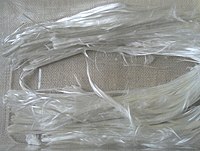 Amphiboles such as tremolite have a crystal structure containing strongly bonded ribbonlike silicate anion polymers that extend the length of the crystal. Serpentine (chrysotile) has a sheetlike silicate anion which is curved and which rolls up like a carpet to form the fiber.[3]
Other materials
Other regulated minerals, such as tremolite , CAS No. 77536-68-6, Ca2Mg5Si8O22(OH)2; actinolite (or smaragdite), CAS No. 77536-66-4, Ca2(Mg, Fe)5(Si8O22)(OH)2; and anthophyllite , CAS No. 77536-67-5, (Mg, Fe)7Si8O22(OH)2; are less commonly used industrially but can still be found in a variety of construction materials and insulation materials and have been reported in the past to occur in a few consumer products.
Other natural and not currently regulated asbestiform minerals, such as richterite, Na(CaNa)(Mg, Fe++)5(Si8O22)(OH)2, and winchite, (CaNa)Mg4(Al, Fe3+)(Si8O22)(OH)2, may be found as a contaminant in products such as the vermiculite containing zonolite insulation manufactured by W.R. Grace and Company. These minerals are thought to be no less harmful than tremolite, amosite, or crocidolite, but since they are not regulated, they are referred to as "asbestiform" rather than although may still be related to diseases and hazardous.
Production trends
In 2005, 2.2 million tons of were mined worldwide. Russia was the largest producer with about 40% world share followed by China and Kazakhstan
Health issues
Chrysotile , like all other forms of industrial , has produced tumors in animals. Mesotheliomas have been observed in people who were occupationally exposed to chrysotile, family members of the occupationally exposed, and residents who lived close to factories and mines. Brown , like all , is hazardous. Blue is commonly thought of as the most dangerous type of . Tremolite often contaminates chrysotile , thus creating an additional hazard.
exposure becomes a health concern when high concentrations of fibers are inhaled over a long time period. People who become ill from are almost always those who are exposed on a day-to-day basis in a job where they work directly with the material. As a person's exposure to fibers increases, either by breathing more fibers or by breathing fibers for a longer time, that person's risk of disease also increases. Disease is very unlikely to result from a single, high-level exposure, or from a short period of exposure to lower levels.
 Other -related diseases
- warts – caused when the sharp fibers lodge in the skin and are overgrown causing benign callus-like growths.
- Pleural plaques – discrete fibrous or partially calcified thickened area which can be seen on X-rays of individuals exposed to . They do not become malignant or cause other lung impairment.
- Diffuse pleural thickening – similar to above and can sometimes be associated with is. Usually no symptoms shown but if extensive can cause lung impairment.
Is Coffee Good or Bad For You? The Pros & Cons of Coffee Drinking
Sunday, August 10, 2008Do you like coffee? I do, it's taste and aroma make my mornings so much better! But I heard that regular coffee drinking can have some negative effects on my health, so I decided to do my own little research and here is what I have found:
Coffee Pros
- 1. Antioxidants. Coffee is rich in antioxidants like chlorogenic acid and melanoidins. Antioxidants help prevent oxidation, a process that causes damage to cells and contributes to aging.
- 2. Parkinson's disease. Regular coffee drinking reduces the risk of Parkinson's disease. A number of studies [1],[2] have demonstrated that people who drink coffee on a regular basis are significantly less likely to develop Parkinson's disease.
- 3. Diabetes. Coffee drinking has the potential to protect against the development of type 2 diabetes. A prospective study[3] as part of the US Nurses Health Study found that moderate consumption of both caffeinated and decaffeinated coffee may lower the risk of type 2 diabetes in younger and middle aged women.
- 4. Liver cirrhosis. Coffee drinking may protect against liver cirrhosis, especially alcoholic cirrhosis.
- 5. Gallstones. There is some evidence [4] that coffee drinking may be protective against gallstone formation in both men and women.
- 6. Kidney stones. Coffee consumption lowers the risk of kidney stones formation. Coffee increases the urine volume, preventing the crystallization of calcium oxalate, the most common component of kidney stones.
- 7. Improved mental performance. Caffeine in coffee is a well-known stimulant. Coffee promotes alertness, attention and wakefulness. The cup of coffee can also increase information processing.
- 8. Alzheimer's disease. Regular coffee drinking may help to protect against Alzheimer's disease. Recent study [5] in mice showed that caffeine equivalent to 5 cups of coffee per day reduced the build up of destructive plaques in the brain.
- 9. Asthma. Caffeine in coffee is related to theophylline, an old asthma medication. Caffeine can open airways and improve asthma symptoms.
- 10. Caffeine safety. In 1958, caffeine was placed on the Food and Drug Administration's list as generally recognized as safe.
Coffee Cons
- 1. Heart disease. This is somewhat controversial. Most prospective cohort studies haven't found that coffee consumption is associated with significantly increased risk of cardiovascular disease.
On one hand, diterpenes cafestol and kahweol present in unfiltered coffee and caffeine each appear to increase risk of coronary heart disease. High quality studies [6] have confirmed the cholesterol-raising effect of diterpenes. Also, coffee consumption is associated with an increase of plasma homocysteine, a risk factor for coronary heart disease.
On the other hand, a lower risk of heart disease among moderate coffee drinkers might be due to antioxidants found in coffee.
- 2. Cholesterol. Heavy consumption of boiled coffee elevates blood total and LDL ("bad") cholesterol levels [7]. Unfiltered coffee contains two cholesterol-raising compounds cafestol and kahweol.
- 3. Blood vessels. Coffee negatively affects the blood vessel tone and function.
- 4. Heart rhythm disturbances. Coffee can cause rapid or irregular heartbeats (cardiac arrhythmias).
- 5. Blood pressure. Although coffee drinking is not a significant risk factor for hypertension, it produces unfavorable effects on blood pressure [8] and people prone to hypertension may be more susceptible. Recent Italian study found that coffee drinking can slightly increase the risk for development of sustained hypertension in people with elevated blood pressure.
- 6. Osteoporosis. Coffee intake may induce an extra urinary excretion of calcium. Heavy coffee consumption (600 ml or more) can modestly increase the risk of osteoporosis, especially in women with a low calcium intake [9].
- 7. Heartburn. A cup of coffee can trigger the heartburn.
- 8. Sleep. Most are aware of the stimulatory effects of caffeine. High amounts of caffeine taken before going to sleep can cause difficulty falling asleep, tendency to be awakened more readily by sudden noises, and a decreased quality of sleep. However, some people can drink coffee and fall right asleep.
- 9. Dehydration. The caffeine in coffee is a mild diuretic and can increase urine excretion. This effect may be easily neutralized by drinking an extra glass of water.
- 10. Dependence. Although "generally recognized as safe" by the FDA, caffeine is still a drug, a mild central nervous system stimulant, and it produces dependence. Caffeine withdrawal is a real syndrome. You may get a few days of headache and irritability if you choose to quit drinking coffee, however, it is relatively easy to break this habit, and most people are not addicted to caffeine.
And here is the list of studies to confirm some points:
1. Saaksjarvi K, Knekt P, Rissanen H, Laaksonen MA, Reunanen A, Mannisto S. Prospective study of coffee consumption and risk of Parkinson's disease. PubMed
2. Hu G, Bidel S, Jousilahti P, Antikainen R, Tuomilehto J. Coffee and tea consumption and the risk of Parkinson's disease. PubMed
3. van Dam RM, Willett WC, Manson JE, Hu FB. Coffee, caffeine, and risk of type 2 diabetes: a prospective cohort study in younger and middle-aged U.S. women. Diabetes Care. PubMed
4. Leitzmann MF, Stampfer MJ, Willett WC, Spiegelman D, Colditz GA, Giovannucci EL. Coffee intake is associated with lower risk of symptomatic gallstone disease in women. Gastroenterology. PubMed
5. Arendash GW, Schleif W, Rezai-Zadeh K, Jackson EK, Zacharia LC, Cracchiolo JR, Shippy D, Tan J. Caffeine protects Alzheimer's mice against cognitive impairment and reduces brain beta-amyloid production. Neuroscience. PubMed
6. Urgert R, Essed N, van der Weg G, Kosmeijer-Schuil TG, Katan MB. Separate effects of the coffee diterpenes cafestol and kahweol on serum lipids and liver aminotransferases. PubMed
7. Urgert R, Weusten-van der Wouw MP, Hovenier R, Lund-Larsen PG, Katan MB. Chronic consumers of boiled coffee have elevated serum levels of lipoprotein(a). PubMed
8. Winkelmayer WC, Stampfer MJ, Willett WC, Curhan GC. Habitual caffeine intake and the risk of hypertension in women. PubMed
9. Hallstrom H, Wolk A, Glynn A, Michaelsson K. Coffee, tea and caffeine consumption in relation to osteoporotic fracture risk in a cohort of Swedish women. PubMed


